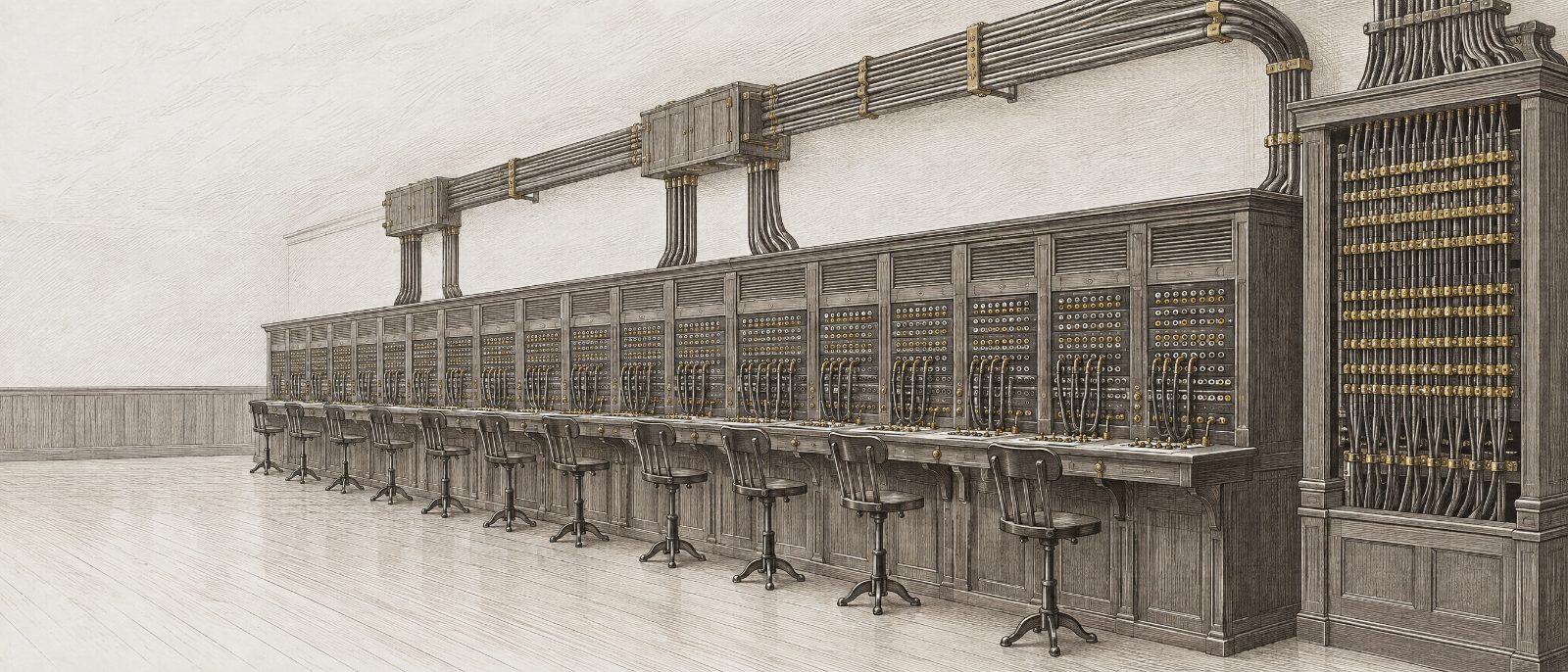
How many systems does a company run?
About a thousand, and most of them alone. MuleSoft’s 2026 survey of 1,050 IT leaders puts the average at 957 applications, with 27% of them connected, and IT teams spending 36% of their time building custom integrations.1 A year earlier, 95% said they struggle to integrate data across systems.2
The data inside them is not ready either. Data leaders estimate 26% of their company’s data is untrustworthy and 19% is siloed or unusable, and 84% say their data strategy needs a complete overhaul for AI.3
What breaks when AI sits on one system?
The answer it gives is only as whole as the system it reads. An assistant connected to the CRM alone does not know the customer has three open support escalations and stopped logging in last month. It answers confidently from the part it can see.
The research says it plainly. In MuleSoft’s survey, 86% of IT leaders say that without proper integration, AI agents add complexity rather than value.1 Gartner warns that fragmented systems mean agents “will scale the fragmentation,”4 predicts organizations will abandon 60% of AI projects that lack AI-ready data,5 and expects over 40% of agentic AI projects to be canceled by the end of 2027.6
How do AI platforms reach business systems now?
Through connectors, and more and more through the Model Context Protocol (MCP). 39% of IT leaders say they already use it.1 The good news for security teams: the main platforms now act as the person signed in, with the permissions that person already has in the source system.
Claude inherits each person’s permissions from the connected service.8 ChatGPT’s company knowledge reaches only what each user is already allowed to view.9 Microsoft’s Sales agent applies the CRM’s existing access controls, for Dynamics 365 Sales and Salesforce alike.10 Gemini Enterprise’s Salesforce connector respects object permissions, field security and sharing rules.11 Salesforce’s own hosted MCP servers, generally available since April 2026, run every call as the authenticated user.12
Two things to plan for. A connector set up with one shared credential reaches whatever that credential can, whoever is asking.8 And MCP itself makes authorization optional, so a server built in house is only as careful as the team that built it.7 Write actions deserve the same care: Gemini’s Salesforce connector, for one, ships read only, with writing off until an admin turns it on.11
Which way should the systems be joined?
It depends what the joined data is for. A forecast needs one clean history; a deal alert needs a change the minute it happens. Figure 1 sets six patterns side by side.
Warehouse first tools move trusted warehouse data back into the CRM and other working tools.13 A semantic layer defines a metric once and refreshes it everywhere it is used, and AI tools can query those governed metrics directly.14 Zero copy keeps data fresh without copying it, at a cost when queries run often.15 In practice a company uses two or three of these at once. MCP sits on top of any of them: it changes how AI reaches the data, not whether the data is joined or clean.
| Pattern | What it is | Good for | Watch for |
|---|---|---|---|
| Point to point | Each pair of systems wired directly | Two or three systems, fast to start | Ten systems can need 45 links, each with its own mapping and failure |
| Integration platform | One platform holds the mappings, retries and monitoring | Many systems that change often | A platform to run and a team to own it |
| Warehouse first | Every system lands in one warehouse; clean records sync back out | One customer record and its history, for scoring and forecasts | As fresh as the sync, so less suited to live deal actions |
| Semantic layer | Each metric defined once, read the same everywhere | Ending two numbers for one metric; AI reads governed metrics | Does not fix bad source data |
| Zero copy | Data queried where it sits instead of copied | Fresh data with nothing duplicated | Query costs can spike at high volumes |
| Event streams | Changes sent as they happen | Near real time signals: a usage drop, an escalation | Costs the most to run; needs schema discipline |
What does sales see once they’re joined?
The customer, not the opportunity. Some of it is already in the products: Salesforce’s deal health joins opportunity scores with email, call recordings and service cases,16 and its account management builds account briefs and summarizes recent interactions.16 Microsoft’s Sales agent draws on the CRM, Microsoft Graph and Microsoft 365 apps.10
The most useful joins cross teams that rarely share data. Product usage predicts renewal: Gainsight, analyzing its own customers, found the share of users active each day among the strongest signs a customer renews.18 And activity has to land as CRM data to count: in older Salesforce setups, captured emails never become CRM records or reach standard reports.17 For what this does to a forecast, see why sales forecasts miss.
Where should a company start?
Our read, from the work we do: before choosing an AI platform, do four things.
Map the systems and who owns each record. Which system is right about the customer, the contract, the usage and the case, when two of them disagree.
Give the customer one key. The same account ID in the CRM, billing, support and product, so a join is a lookup, not a guess.
Define the numbers once. Pipeline, bookings, ARR and churn, written as code in one place.
Connect AI as the person, never as a shared account. Each answer then respects what the asker may see, and the source system’s audit log says who asked.
Then add AI one use at a time, each checked against a number that will be known later: a renewal, a close, a quarter.
References
- MuleSoft (Salesforce), “2026 Connectivity Benchmark Report Insights.” February 2026. blogs.mulesoft.com
- Salesforce, “MuleSoft Connectivity Report announcement.” January 2025. salesforce.com
- Salesforce, “Study: 84% of Technical Leaders Need Data Overhaul for AI Strategies to Succeed.” November 2025. salesforce.com
- Gartner, “Gartner Predicts AI Agents Will Outnumber Sellers 10 to 1 by 2028, Yet Fewer Than 40% of Sellers Will Say Agents Improved Productivity.” July 2026. gartner.com
- Gartner, “Lack of AI-Ready Data Puts AI Projects at Risk.” February 2025. gartner.com
- Gartner, “Gartner Predicts Over 40% of Agentic AI Projects Will Be Canceled by End of 2027.” June 2025. gartner.com
- Model Context Protocol, “Authorization,” specification 2025‑06‑18. github.com
- Anthropic, “Use connectors to extend Claude’s capabilities.” Claude Help Center, read November 2026. support.claude.com
- OpenAI, “Company knowledge in ChatGPT.” Help Center, read November 2026. help.openai.com
- Microsoft, “Sales agent FAQ.” Microsoft Learn, read November 2026. learn.microsoft.com
- Google Cloud, “Salesforce configuration.” Gemini Enterprise documentation, read November 2026. docs.cloud.google.com
- Salesforce Developers, “Salesforce Hosted MCP Servers Are Now Generally Available.” April 2026. developer.salesforce.com
- Hightouch, “Data activation concepts.” Read November 2026. hightouch.com
- dbt Labs, “dbt Semantic Layer.” Read November 2026. docs.getdbt.com
- Salesforce Architects, “Data 360 Interoperability.” Read November 2026. architect.salesforce.com
- Salesforce Help, “AI Solutions for Sales Pipeline Visibility and Forecasting.” Read November 2026. help.salesforce.com
- Salesforce Help, “Using Emails Without Sync Email as Salesforce Activity in Einstein Activity Capture.” Read November 2026. help.salesforce.com
- Gainsight, “Our Top Indicators of Renewal.” gainsight.com